

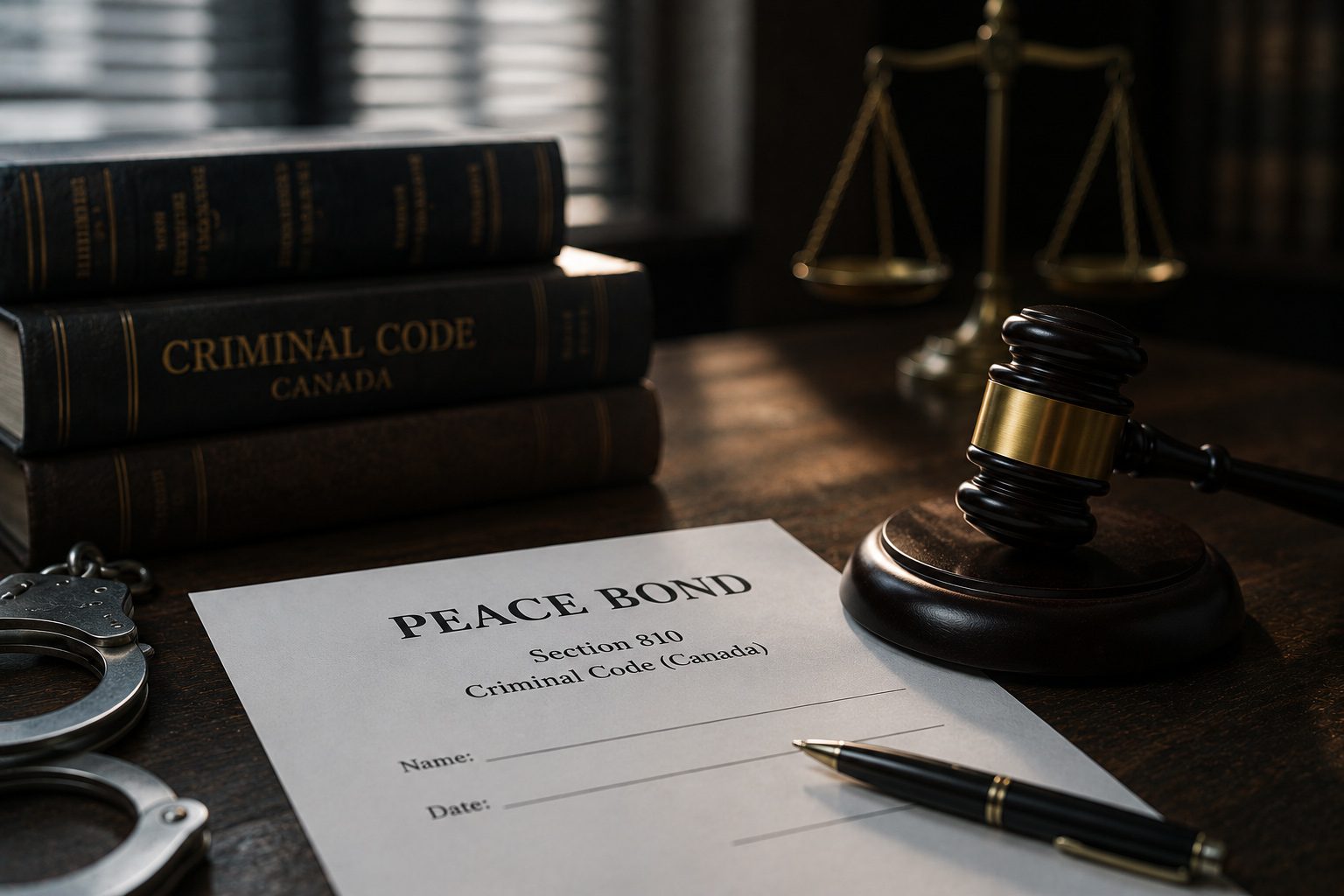
1. What is a Section 810 Peace Bond?
Under Section 810 of the Criminal Code of Canada, a peace bond is a court order requiring an individual to “keep the peace and be of good behaviour” for a specified period, usually 12 months. It is typically sought when an individual (the informant or applicant) fears that another person (the accused), will cause injury to them, their intimate partner, or their child, or that they will damage their property.
It is important to understand the fundamental nature of this order: a peace bond is not a criminal conviction. You are not pleading guilty to a crime by entering into one. However, it is a court order with specified conditions that you must follow. Failing to abide by the conditions can lead to further criminal charges as well as financial consequences.
2. The Legal Threshold
For a judge or justice of the peace in Alberta to order a Section 810 peace bond, they must be satisfied by evidence that the applicant has reasonable grounds for their fear. Canadian common law mandates an objective test: it is not enough for the applicant to simply be subjectively afraid. A reasonable person, looking at the same circumstances and evidence, must also conclude that there are grounds for that fear.
3. Common Conditions Attached to a Peace Bond
A peace bond is rarely just a promise to “be of good behaviour.” In Alberta, the courts will frequently attach specific, restrictive conditions tailored to the circumstances. These often include:
No-contact orders prohibiting direct or indirect communication with the applicant or their family.
No-go clauses preventing you from visiting the applicant’s home, workplace, or school, often specifying a radius (e.g., 500 meters).
Weapons prohibitions, which routinely require you to surrender firearms and weapons.
Requirements to attend counselling or abstain from non-prescription drugs and alcohol (if those factors are deemed relevant to the feared behaviour).
4. The Consequences of a Breach (Section 811)
This is the most critical risk associated with peace bonds. Under Section 811 of the Criminal Code, breaching any condition of a peace bond is a standalone criminal offence. For example, if you send a text message to the applicant, and there is a no-contact condition in place with the said applicant on the 810 peace bond, you can be arrested and criminally charged.
A breach of a peace bond is a hybrid offence. If the Crown proceeds by indictment, the maximum penalty is four years in prison. If the Crown proceeds summarily, the maximum penalty is 18 months in prison. More importantly, unlike the peace bond itself, a conviction for breaching a peace bond can leave you with a permanent criminal record which in turn can impact your immigration status, employment prospects and reputation.
5. Protect Your Rights with White and Jeet Law
A Section 810 peace bond might not be a criminal conviction, but its restrictions and the potential consequences of a breach are serious. Before you enter into a peace bond and admit on the record that someone has reasonable grounds to fear you, it is vital to seek experienced legal advice.
White and Jeet Law will thoroughly review the allegations against you, advise you on your options under the Criminal Code and common law, and aggressively defend your rights in court to ensure you are not subjected to unnecessary or unfair restrictions.